
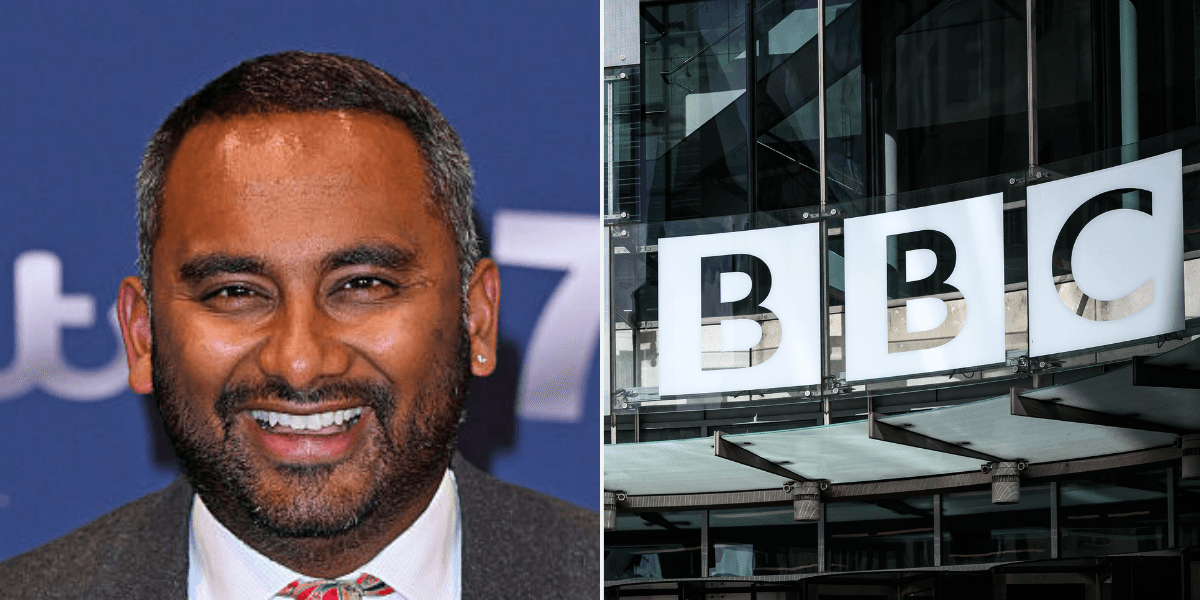
BBC dealt fresh blow as departing Amol Rajan predicts broadcaster will shrink at ‘accelerating rate’

Amol Rajan, the departing presenter of BBC Radio 4’s Today programme, has delivered a stark assessment of the corporation’s future.
The journalist declared that BBC News will inevitably “get smaller at an accelerating rate” in the coming years.
Mr Rajan, who revealed earlier this year his plans to leave the BBC to “unleash my inner entrepreneur”, told the Political Currency podcast that he wanted to move to where “the action is, and that’s YouTube.”
The veteran presenter, who spent a decade in print before a further 10 years in broadcasting, acknowledged he had consistently found himself working in sectors experiencing rapid decline.

Amol Rajan has delivered a stark assessment of the future facing BBC News
|
GETTY
He described the Today programme as “the last big mass-market news programme,” stressing that it was an exception to his broader argument about the BBC’s trajectory.
The University Challenge host’s remarks arrive as the BBC faces severe financial constraints, with the corporation needing to find £500m in savings over the next two years.
The public broadcaster is grappling with a licence fee that continues to lose real value, compounded by a rising number of households choosing not to pay it.
The BBC and other traditional broadcasters have been pushing for their content to be given greater visibility on platforms such as YouTube and TikTok.

The journalist said he wants to move to where ‘the action is’ as he turns his attention to YouTube
|
GETTY
The shift away from scheduled television viewing has intensified these demands.
The corporation has already taken steps to adapt, announcing a new partnership dedicated to producing content specifically for YouTube.
Director-general Matt Brittin has made engaging younger audiences one of his priorities.
At the Edinburgh TV festival on Wednesday, Pedro Pina, YouTube’s head for Europe, the Middle East and Africa, used the prestigious MacTaggart lecture to push back against this narrative.

The BBC is facing mounting financial pressure as it seeks £500m in savings over the next two years
|
GETTY
“That is how the story usually goes, like a well-scripted tragedy,” Mr Pina said.
“We have our once great hero, we have their terrible downfall, and on platforms like YouTube we have an obvious villain. It’s a powerful story. An emotive story. The trouble is that it is not true.”
Mr Pina argued that traditional broadcasters and digital platforms could thrive side by side, drawing a parallel with painters who continued to prosper following the arrival of photography.
He did, however, acknowledge that television companies could no longer rely on the position they once held during the golden age of broadcasting, before the prevalence of social media.
Mr Pina criticised plans to make YouTube promote public service broadcasters more, which could mean independent creators get less attention.
The policy has been championed as a means of tackling online misinformation.
“Forced prominence would impair the public interest by unfairly shifting focus from independent creators and production companies, and by recommending that all our viewers watch the same things, disregarding personal taste,” he warned.
The Vice President of YouTube cautioned that such legislation could jeopardise the livelihoods of UK-based creators and production companies, while forcing viewers to sift through unwanted content.

Pedro Pina argued that YouTube and traditional broadcasters can thrive alongside one another
|
GETTY
This, he suggested, risked eroding the very public trust that British broadcasters have spent decades cultivating.
Not everyone at the festival shared Mr Pina’s optimistic vision of coexistence, however.
Kevin Lygo, ITV’s managing director of media and entertainment, questioned the validity of YouTube’s rhetoric about supporting British content and its actual financial commitment.
Mr Lygo pointed to YouTube’s recent pledge of £3m to invest in the UK’s creator economy and television industries, a figure he said “made him chortle” when set against ITV’s estimated £1.2bn spending on content this year alone.

Comments are closed.