
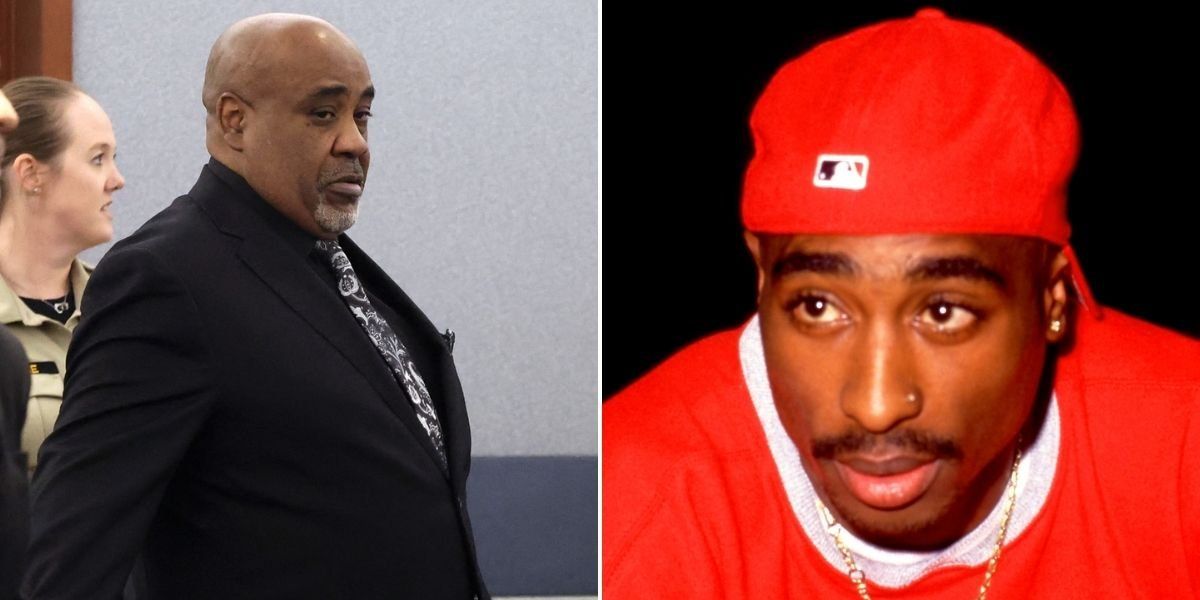

A Las Vegas jury has convicted former gang leader Duane “Keffe D” Davis of first-degree murder with a deadly weapon in connection with the 1996 killing of rap superstar Tupac Shakur.
The panel reached its verdict on Monday after deliberating for fewer than three hours following nine days of witness testimony from detectives, former gang associates and documentary makers.
Davis, now 63, was found to have committed the murder with the intent to promote or assist a criminal gang.
He is the sole individual ever to face charges over Mr Shakur’s death near the Las Vegas Strip nearly three decades ago.

A Las Vegas jury has convicted former gang leader Duane “Keffe D” Davis of first-degree murder
|
GETTY
The conviction carries a potential sentence of life imprisonment without parole. Clark County District Court Judge Carli Kierny has scheduled sentencing for October 13.
Prosecutors maintained that Davis, a former leader of the South Side Compton Crips, did not personally pull the trigger but instead masterminded the attack and provided the firearm used in the shooting.
The weapon was allegedly handed to his nephew Orlando Anderson, who opened fire from a white Cadillac as Shakur travelled to a club performance on September 7, 1996.
According to the prosecution’s case, the drive-by was carried out in retaliation for a physical altercation between Anderson and Mr Shakur’s entourage at a Las Vegas venue just hours before the shooting.

Duane Davis (C) and his attorney Michael Sanft are led back to a courtroom to hear his sentencing date after a jury found Davis guilty in the 1996 killing of rapper Tupac Shakur
|
GETTY
Anderson consistently denied any role in Shakur’s death. He was killed in 1998 during a separate incident at a car wash in Compton, California, reportedly over a drugs dispute.
Authorities said his death bore no connection to the Shakur case. The prosecution’s case rested primarily on Davis’s own repeated admissions.
In a confidential 2008 police interview, conducted as part of the investigation into the murder of rapper Notorious B.I.G., he acknowledged being present in the vehicle from which the fatal shots were fired.
Davis went further still in his 2019 memoir, Compton Street Legend, and in numerous podcast and documentary appearances.

Tupac Shakur was killed in 1996
|
GETTY
These public disclosures voided a protective agreement with authorities that had previously shielded him from prosecution, and the court ruled his police interview admissible at trial.
Prosecutor Binu Palal urged jurors to take Davis at his word.
“When you have the shot caller sitting shotgun when shots are fired, there’s no doubt he’s responsible,” he told the panel.
Defence lawyer Michael Sanft countered that his client’s statements amounted to nothing more than fabricated boasting designed to generate book sales.
“There’s no proof,” he argued. Shakur was just 25 when he was gunned down at the pinnacle of his career, having sold more than 75 million records worldwide.

Duane Davis (C) and his attorney Michael Sanft are led back to a courtroom to hear his sentencing date after a jury found Davis guilty in the 1996 killing of rapper Tupac Shakur
|
GETTY
Earlier in 1996, he had released All Eyez on Me, the first double studio album by a solo hip-hop artist, cementing his status as a cultural icon.
His killing took place amid fierce rivalry between the East Coast and West Coast rap scenes, intertwined with gang feuds between the Bloods and Crips.
As the verdict was announced, Shakur’s family members held hands, with his sister Sekyiwa “Set” Shakur weeping quietly before embracing a prosecutor. Outside the courtroom, devoted fans were seen both crying and cheering.
Davis stood expressionless as the decision was read. He briefly raised his fist towards the public gallery while being led out, before telling the judge: “I would like to appeal this matter.”

Comments are closed.