

Simon Reeve reflected on the incredible moment he and his team on Wilderness managed to make history by capturing footage of the elusive tenkile tree kangaroo in its natural habitat in Papua New Guinea.
The presenter described the extraordinary encounter as a once-in-a-lifetime convergence of circumstances.
“I think we turned up at the Goldilocks moment when their numbers have just increased over the last few years, and no other telly team have been out there,” Mr Reeve told GB News and other press.
He attributed the achievement partly to the continued existence of untouched landscapes across the globe.
“I think it’s partly that there are still wild and wonderful places out there,” he said. “The stars aligned, planets aligned to make it possible for us.”
 Simon Reeve talked about keeping the second series of BBC’s Wilderness engaging rather than preachy | BBC
The expedition took Mr Reeve and a small team deep into the Torricelli Mountains in Papua New Guinea’s remote northwest, a region so cut off that only a handful of scientists have ever set foot there.
Researchers believe thousands of species in the area remain undocumented.
With no roads past the forest’s edge and the closest hospital more than a day’s travel away, the journey proved among the most punishing of Mr Reeve’s career.
The crew navigated punishing jungle gradients, river crossings and unrelenting tropical downpours over several days.
Their target was one of the planet’s rarest mammals: the tenkile, a tree kangaroo species unique to these mountains that was once thought to be teetering on the brink of extinction.

Simon Reeve and the Wilderness team managed to capture footage of the tenkile
|
BBC
After days of arduous trekking, the team finally reached the high-altitude forest where the animal is known to dwell.
Mr Reeve was clear about who deserved the credit for the landmark footage, pointing to the communities living alongside the wildlife.
“Really, it’s because of the villagers. We latched onto brilliant people who were genuinely promising that they felt really sure we had a decent chance of seeing them,” he said.
He stressed that conservation in these regions is frequently driven by local people rather than outside experts.

The opening episode of the new series followed Mr Reeve as he journeys into Papua New Guinea’s rainforests
|
BBC“It’s not just locals who are doing field work; it’s often locals who are leading it, who are with real passion and skin in the game,” he said. “They really believe in it and care about it.”
Communities that previously hunted tree kangaroos have transformed into their protectors, re-establishing protected zones where wildlife is given space to recover.
“They’re re-establishing those no-hunt, no-take zones, which you need on land or on the sea, because when you stop killing stuff, life can bounce back,” Mr Reeve added.
The author and journalist expressed strong confidence that the latest run of Wilderness surpasses its predecessor. “I think it’s better than series one. I think it’s bigger and bolder,” he said.
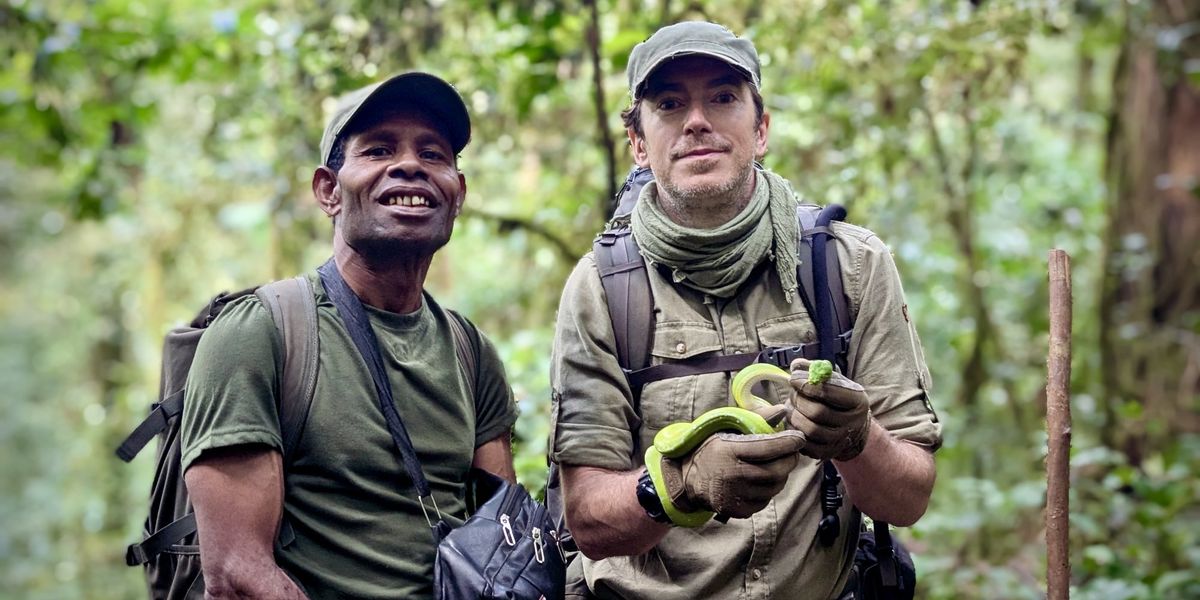
 Simon Reeve with conservationist Caleb Bulu in Torricelli Mountains, Papua New Guinea | BBC
The success of the first outing gave the production team belief in what they could accomplish.
“We realised not just that there was an appetite for it from the lovely viewers, but that we actually were vaguely capable of doing this,” he said.
Mr Reeve also acknowledged that the encouragement of colleagues helped push him beyond his natural caution.
“His positivity and the team’s positivity encouraged me, as a negative, ‘that’ll never work’ sort of character, to go for it,” he said.
Yet the spectacular landscapes captured in the series face mounting pressure, with logging roads and deforestation encroaching ever closer to the Torricelli Mountains.

Comments are closed.