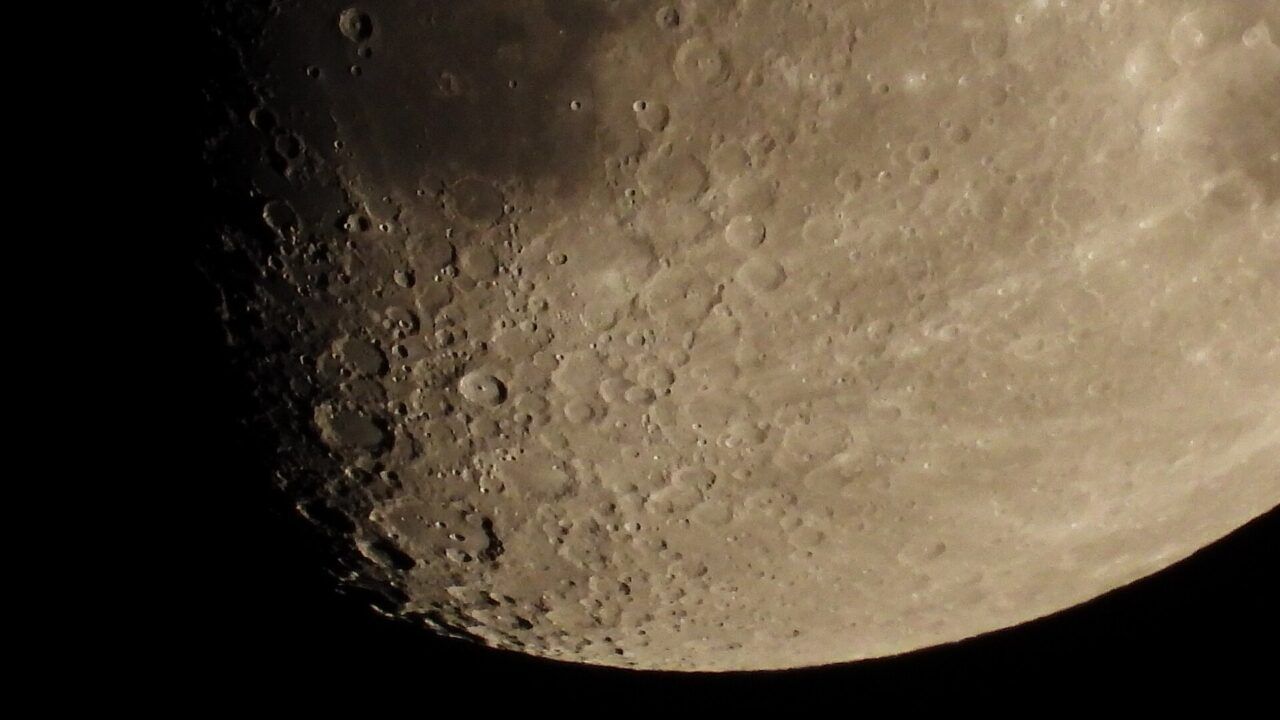
On the Moon's near side sits a collapsed lava tube with a skylight in its roof — and, according to new analysis, a tunnel entrance that could lead into one of the most valuable pieces of real estate in the solar system: a cave large enough to shelter a lunar base.
The feature, studied by an international team using radar data, lies in the Sea of Tranquility, not far from where Apollo 11 landed. The researchers concluded that the pit connects to a subsurface conduit — a hollow tube carved by lava billions of years ago, when the Moon was volcanically alive. The access point, if their modelling holds, opens into a void beneath the surface that could extend for tens of metres or more.
Caves change the lunar equation. On the surface, astronauts face radiation that has no atmosphere to stop it, micrometeorites, and temperature swings of hundreds of degrees between lunar day and night. Inside a lava tube, metres of rock solve all three problems at once. Mission designers have long argued that the first permanent lunar outposts will not be built so much as moved into — and every confirmed candidate cave is a site survey for that future.
The challenge is confirmation. Everything known comes from orbiters looking down; nobody has rattled the cave's ceiling or sent a camera to its floor. The analysis argues that radar returns fit a sloping floor and an open conduit — the strongest evidence yet that at least one lunar pit is not a dead-end crater but a doorway. Robotic concepts already exist to rappel into such pits and map them: wheeled rovers with winches, hopping drones, tethered scouts.
For Canada, the finding lands on familiar ground. The Canadian Space Agency has invested for decades in exactly the technologies cave exploration demands — robotic arms, autonomous rovers, and the Lunar Exploration Accelerator Program's push to put Canadian hardware on the Moon. A confirmed cave network gives every space agency's roadmap a destination more specific than "the lunar surface."
Sceptics note the distance between a radar echo and a base. Cave floors may be rubble-choked, roofs may be unstable, and the Sea of Tranquility's scientific protections complicate any construction. All true — and all engineering problems, which is to say, solvable ones. The Moon kept its caves hidden for four billion years. Now that we have found a door, someone will eventually go and open it.
The Sea of Tranquility location is poetic but pointed. Humanity's first footsteps landed in a mare basin whose subsurface may have been honeycombed all along — the Apollo astronauts walked a plain underlain, potentially, by the largest natural shelters on the Moon. Lava tubes form when the surface of a lava flow crusts over while molten rock continues beneath, later draining away; on the Moon's low gravity, theory has long predicted tubes far larger than Earth's, wide enough for streets rather than crawlspaces.
The newly analysed pit is one of a family of such skylights photographed by orbiters for fifteen years, most dismissed as inert craters. Reclassifying even one as a cave mouth converts it into infrastructure-in-waiting: a radiation shelter that does not need to be launched, insulated by the Moon itself, at a location humanity has already visited.
That is why a radar echo from Mare Tranquillitatis is resonating through mission planning offices. Bases were always going to be expensive. Caves are the first idea that makes them merely hard.