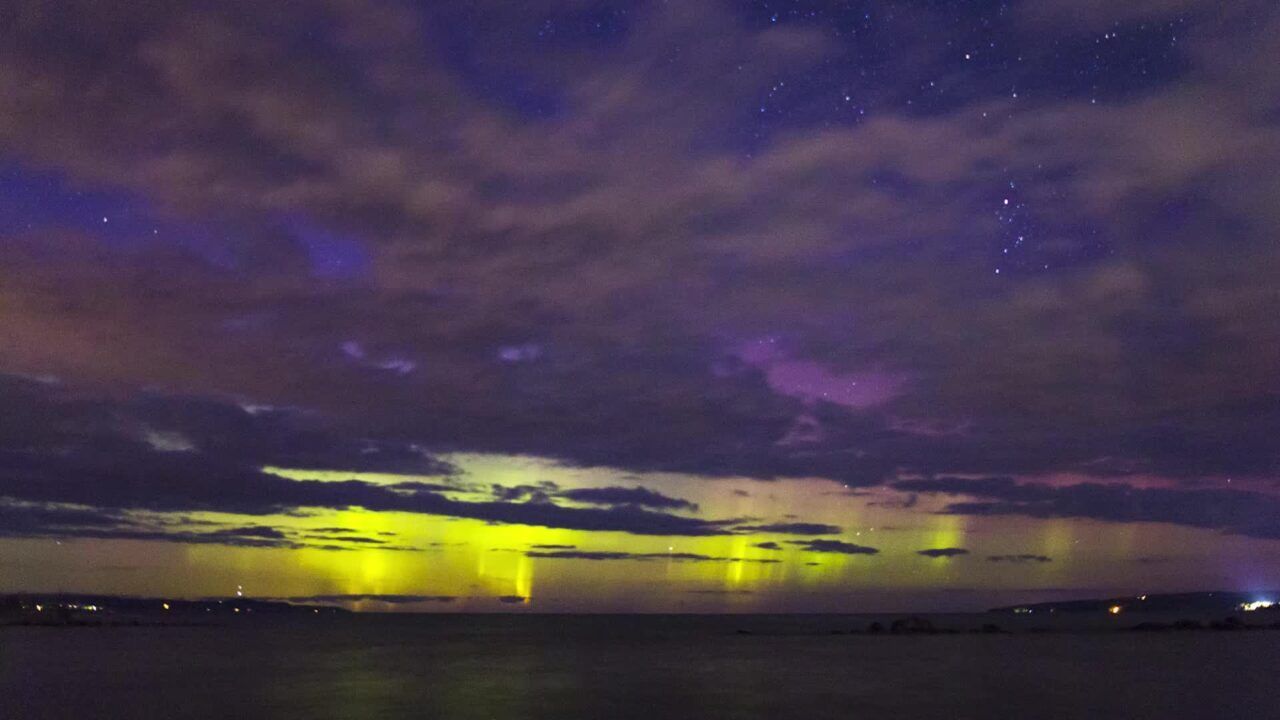
Canadians should look up tonight. A coronal mass ejection hurled from the Sun earlier this week is arriving at Earth, and forecasters say geomagnetic storm conditions could push the northern lights across Canada and deep into the northern United States overnight Thursday into Friday.
The US National Oceanic and Atmospheric Administration's Space Weather Prediction Center forecasts minor to moderate — G1 to G2 — geomagnetic storming for October 9, following an eruption that left the Sun on October 6. The UK Met Office and Australia's Bureau of Meteorology broadly agree, with the southern hemisphere's aurora australis possibly visible from Tasmania and southern New Zealand on Friday night.
For most of Canada, the forecast is a standing invitation: the auroral oval normally hovers over the northern territories and the northern reaches of the provinces, and even modest storms drag it south over populated latitudes. During stronger bursts, displays can spill over cities from Vancouver to Halifax — though forecasters add their standard cautions: timing can shift by hours, clouds and city light can hide a strong display entirely, and a camera will often see colour where the eye sees only a pale glow.
Tonight comes with a bonus act. The Draconid meteor shower peaks after dark, modest in most years at perhaps ten meteors an hour under perfect skies. Astronomy guides rate an outburst this year as unlikely, but a meteor or two across a shimmering aurora is the kind of coincidence worth a warm jacket.
The deeper context is a restless Sun. Solar Cycle 25 remains near its maximum, and the past two years have produced the strongest geomagnetic storms in decades — including events that painted skies over southern Canada and forced airlines, satellite operators and power-grid managers to pay attention. Federal grid operators treat G-scale forecasts as operational inputs: geomagnetically induced currents can stress transformers at high latitudes, a lesson written into Canadian infrastructure planning since the 1989 Quebec blackout.
Space weather agencies advise checking the live forecast before heading out; NOAA's thirty-minute aurora forecast is the skywatcher's standard tool. If the storm arrives on schedule, the best views come from dark skies looking north, in the hours around and after local midnight.
The Sun fired this one off days ago. Tonight, Canada has front-row seats.
For the practical skywatcher, the drill is well rehearsed. Check the space-weather forecast in the evening rather than the morning — storm timing routinely shifts by hours — and favour the darkest available sky, looking north, with patience measured in tens of minutes rather than glances. Phone cameras, with their long exposures, routinely capture structure and colour the naked eye perceives only as shimmering grey-green; many Canadians' best aurora memories began as a surprise on a phone screen.
The power-grid footnote is more than trivia in this country. The March 1989 storm that collapsed Hydro-Québec's network in ninety seconds remains the reference disaster for geomagnetic risk, and it rewrote North American grid standards. Tonight's forecast G1-G2 conditions are routine by comparison — the kind of storm operators absorb without headlines. But the Sun that produced this week's eruption is the same restless one that has delivered the strongest storms in two decades, and the agencies that watch it treat every arrival as practice.
If the clouds cooperate, the practice will be beautiful.